
For UAE retailers, distributors, restaurants and e-commerce shops, inventory is cash sitting on shelves. Too much stock ties up money and warehouse space in Jebel Ali or Al Quoz. Too little means lost sales during Ramadan, White Friday or the Dubai Shopping Festival. AI inventory management uses your sales history and live signals to forecast demand, suggest reorder quantities and flag problems before they cost money. This guide explains what it does, what data it needs and how a UAE SME can start without replacing its whole system.
What AI inventory management does
| Task | Traditional approach | With AI |
|---|---|---|
| Demand forecasting | Last year's numbers plus gut feel | Forecast per SKU using seasonality, promotions, Ramadan and event calendars |
| Reordering | Fixed minimum levels | Dynamic reorder points based on forecast and supplier lead time |
| Slow-moving stock | Found at year-end count | Flagged weekly with suggested discounts or bundles |
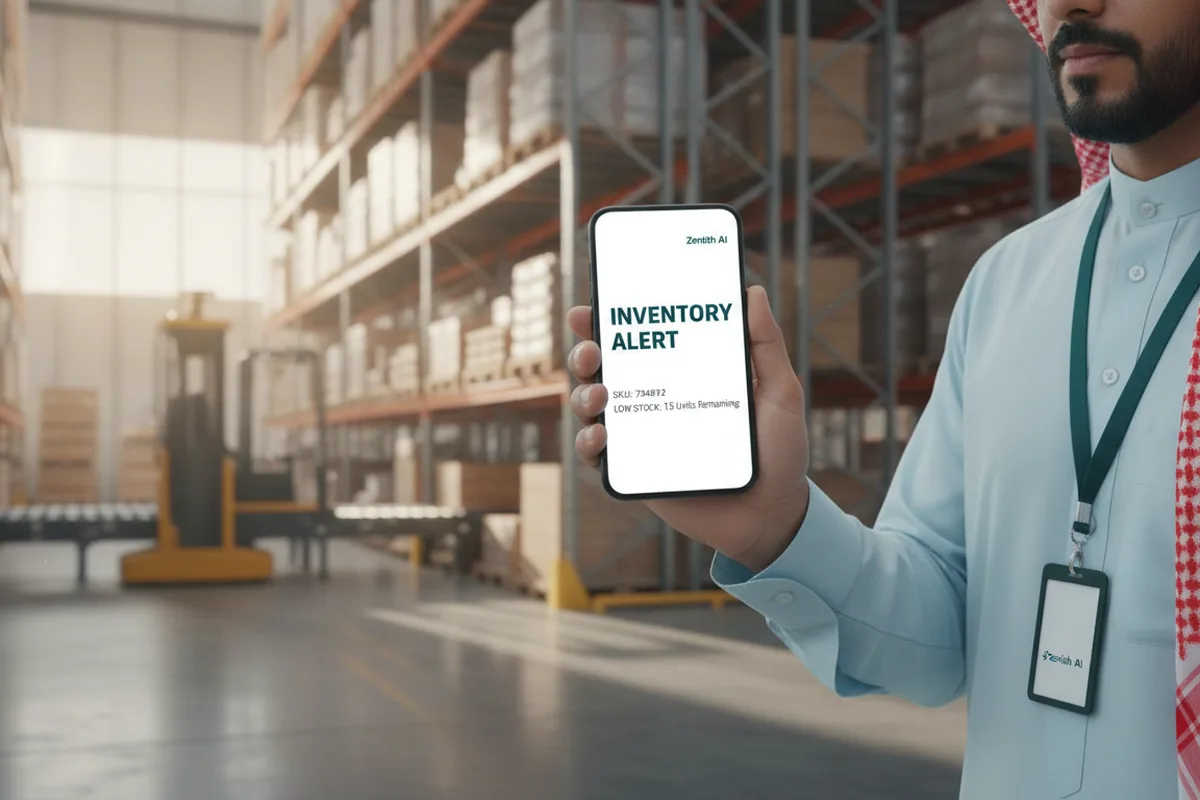
| Stock-outs | Noticed when customers complain | Early alerts before stock runs out |
| Multi-location | Manual transfers | Suggested transfers between branches or warehouses |
| Questions | Someone exports a report | Ask in plain English or Arabic: "What will run out next week?" |
UAE-specific factors the model should know
- Seasonal peaks: Ramadan, Eid, back-to-school, DSF, White Friday and summer slowdowns.
- Import lead times: sea freight from China or India, customs clearance and free-zone transfers.
- Multi-channel sales: your own website, Noon, Amazon.ae, Talabat or Deliveroo, and physical branches.
- Expiry dates: critical for food, pharmacy and cosmetics in hot conditions.
- VAT and corporate tax reporting: stock values feed your accounts. See AI accounting in the UAE.
Data you need to start
- At least 12 months of sales by SKU and location (24 months is better for seasonality).
- Current stock levels and locations.
- Supplier lead times and minimum order quantities.
- Promotion and price change history.
The data does not need to be perfect. A good system flags gaps and still improves on spreadsheets.
How to roll it out
- Pick one category with clear sales history and frequent stock problems.
- Run forecasts in parallel with your current method for four to eight weeks and compare.
- Let buyers approve suggestions before any purchase orders go out automatically.
- Expand to more categories and locations once accuracy is proven.
- Connect alerts to WhatsApp or email so managers act quickly.
What to measure
- Stock-out rate on top-selling SKUs
- Days of inventory and cash tied up in stock
- Write-offs from expiry or obsolescence
- Forecast accuracy by category
Where Zenith fits
Zenith connects to your POS, e-commerce store and accounting system, forecasts demand per SKU and sends reorder and slow-stock alerts to your team on WhatsApp. Buyers stay in control of every order. Many retail clients combine it with WhatsApp abandoned-cart recovery and AI CRM for small businesses. Restaurant groups use it with restaurant automation.
Frequently asked questions
Do I need to replace my ERP or POS?
No. Most AI inventory tools connect to existing systems and add forecasting and alerts on top.
How accurate are AI demand forecasts?
Accuracy depends on data quality and product type. Most businesses see clear gains over manual methods on regular-selling items, with less benefit on new or highly erratic products.
Is it only for large retailers?
No. SMEs with a few hundred SKUs often see the fastest payback because they have less buffer stock and cash.
Can it handle Ramadan demand changes?
Yes, if it is given past Ramadan periods. The dates move each year, so the model must use the Hijri calendar, not fixed months.