
The UAE is moving from PDF and paper invoices to mandatory e-invoicing. For many small and mid-sized businesses, this is the biggest change to how they bill customers since VAT arrived in 2018. Invoices will no longer simply be emailed as PDFs; they will be exchanged in a structured digital format through accredited providers and reported to the tax authority. Businesses that prepare early will barely notice the switch. Businesses that wait may find themselves rushing to replace systems, retrain staff and clean up messy customer data under deadline pressure.
This guide explains in plain language what UAE e-invoicing is, who it applies to, the expected timeline, how the system works, what you need to change inside your business and how AI and automation can make compliance easier. It is a practical overview, not legal or tax advice; always confirm details with the Ministry of Finance, the Federal Tax Authority or your tax adviser, because implementation rules continue to be refined.
What is e-invoicing?
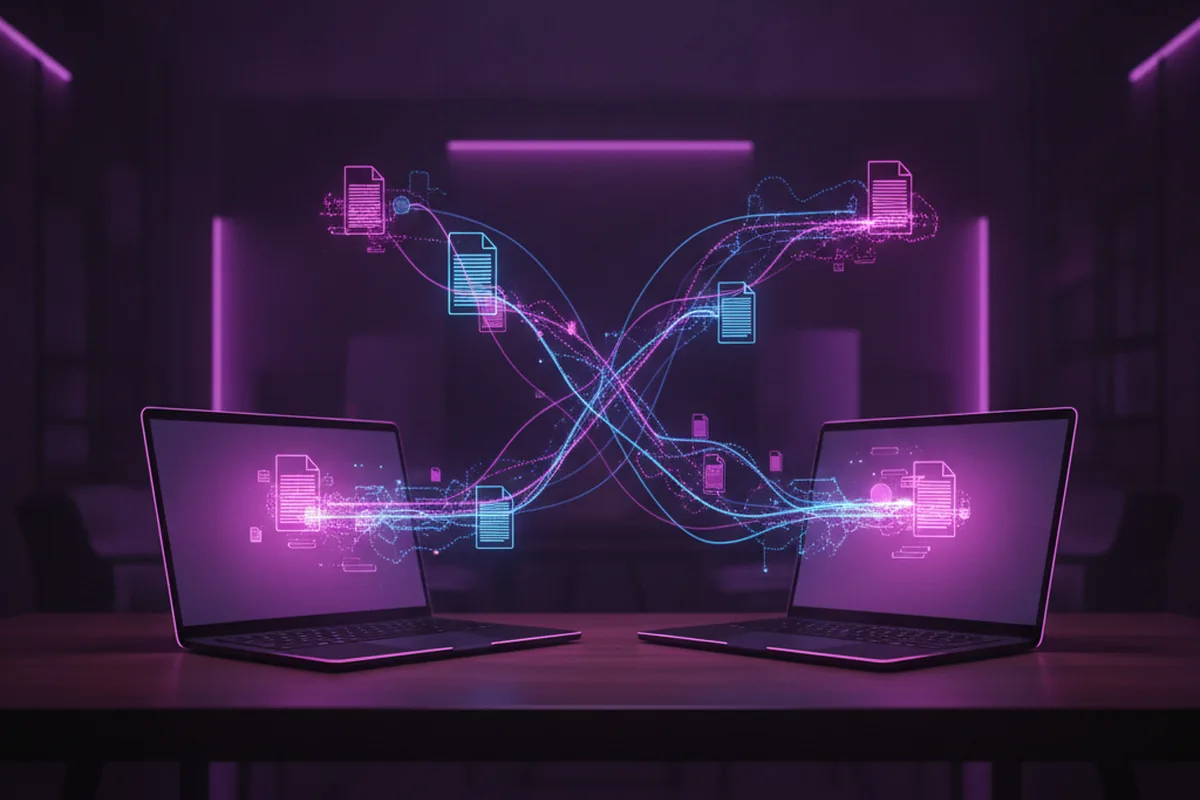
An e-invoice is not a PDF. A PDF is a picture of an invoice that a person reads. An e-invoice is structured data, in a standard format, that the seller's system sends directly to the buyer's system, where it can be processed automatically without retyping. The UAE model also shares invoice data with the tax authority, giving the government near real-time visibility of transactions.
For businesses, the practical effect is simple: invoices must be created in a compliant system, contain the required data fields in the right format, and be sent through an approved channel rather than attached to an email.
How the UAE model works
The UAE has adopted a decentralised model based on the international Peppol framework, often described as a five-corner model:
- The seller creates the invoice in its accounting or ERP system.
- The seller's Accredited Service Provider (ASP) validates the invoice and converts it into the required standard format.
- The buyer's ASP receives the invoice through the Peppol network.
- The buyer receives the structured invoice in its own system.
- The tax authority receives the invoice data reported by the service providers.
In practice, most small businesses will not deal with the network directly. They will use accounting software that connects to an Accredited Service Provider, or use an ASP's own platform, and the technical exchange will happen behind the scenes.
Who has to comply and when
E-invoicing is being introduced in phases under Ministerial Decision No. 244 of 2025, with detailed rules set out in the Ministry of Finance's UAE Electronic Invoicing Guidelines (version 1.1 was published in June 2026). The announced timeline is:
| Group | Appoint an Accredited Service Provider by | Mandatory e-invoicing from |
|---|---|---|
| Pilot participants | As selected | Pilot phase from July 2026 |
| Businesses with annual revenue of AED 50 million or more | 30 October 2026 | 1 January 2027 |
| All other businesses in scope | 31 March 2027 | 1 July 2027 |
| Government entities | As announced | 1 October 2027 |
Rules can be refined, so always confirm the current dates and scope on the Ministry of Finance and Federal Tax Authority websites. The key point for small businesses is that most will fall into the July 2027 phase, and the real first deadline is appointing a provider by 31 March 2027, not the go-live date. If your revenue is above AED 50 million, the provider deadline is days away rather than months.
What will change inside your business
Your invoicing software
If you create invoices in Word, Excel or a basic template, that will no longer be enough. You will need software that can produce compliant structured invoices and connect to an Accredited Service Provider. Many accounting platforms are adding this, but check whether yours will support UAE e-invoicing and when.
Your customer and product data
E-invoices require accurate data: customer legal names, Tax Registration Numbers, addresses, and correct product or service descriptions and tax treatments. Missing or inconsistent data that people currently fix by hand will cause invoices to be rejected. Cleaning your customer master data is one of the most valuable things you can do early.
Your processes
Who creates invoices, who approves them, how credit notes are handled and how incoming supplier invoices are processed will all need to fit the new flow. Incoming e-invoices are also an opportunity: they arrive as data, so they can be matched to purchase orders and posted automatically.
Your records
Record-keeping obligations continue. Make sure your system stores invoices and related data in a way your accountant and the authority can rely on.

Types of e-invoices and documents
The framework covers more than standard tax invoices. Businesses should expect to handle, in structured form:
- Standard tax invoices for business-to-business and business-to-government supplies.
- Credit notes for returns, discounts and corrections, linked to the original invoice.
- Commercial invoices where no VAT is charged but the transaction is in scope.
- Self-billing and special cases, such as invoices issued by the buyer on behalf of the supplier where agreed, and supplies involving free zones or exports, which follow specific rules in the guidelines.
Step by step: how an e-invoice moves
- Your system creates the invoice with all required data fields.
- It is sent to your Accredited Service Provider, which validates the data against the UAE rules.
- If validation fails, the invoice is rejected and returned for correction before it reaches the customer.
- Valid invoices are converted to PINT-AE and transmitted through the Peppol network to the buyer's provider.
- The buyer's provider delivers it into the buyer's system, where it can be processed automatically.
- Invoice data is reported to the tax authority by the service providers.
- Both sides archive the e-invoice according to record-keeping rules.
Scope and exclusions
The mandate focuses on business-to-business and business-to-government transactions. Business-to-consumer sales are treated differently, and certain categories of transactions are excluded or phased differently under the guidelines. Because scope details matter for sectors such as financial services, international transport and some government-related activities, review the current guidelines or ask your tax adviser to confirm exactly which of your transactions are in scope.
Choosing an Accredited Service Provider: a checklist
- Is the provider officially accredited for the UAE programme?
- Does it integrate natively with your accounting or ERP system, or will you need custom work?
- How are validation errors reported, and how quickly can your team fix them?
- Does it handle incoming supplier e-invoices as well as outgoing ones?
- What are the pricing model, contract length and onboarding support?
- Where is data stored, and how long is it archived?
- Can it support Arabic and English and multiple legal entities if you have them?
The data an e-invoice needs
The exact specification is defined in the UAE's data dictionary for e-invoicing, which builds on the Peppol international invoice standard with UAE-specific fields. You do not need to memorise it, but you should recognise the kind of data your system must hold for every invoice:
- Seller and buyer legal names, addresses and Tax Registration Numbers (or other identifiers where the buyer has no TRN)
- Invoice number, issue date and invoice type (for example, standard invoice or credit note)
- Currency and, where relevant, exchange rate information
- Line items with clear descriptions, quantities, unit prices and item-level tax categories
- VAT rate and amount per line and in total, including zero-rated and exempt items where they apply
- Payment terms and due date
- References to purchase orders or contracts where the buyer requires them
If any of this lives only in someone's head or in free-text notes today, that is where rejections will come from. Fixing it is mostly a data and process exercise, not a technology one.
What it looks like for different businesses
Trading and wholesale
High invoice volumes, many customers and frequent credit notes for returns and price adjustments. Clean customer TRNs and consistent product codes matter most, and automatic matching of incoming supplier e-invoices to purchase orders can remove hours of manual work each week.
Clinics and service businesses
Many invoices may go to individuals rather than businesses, which affects which transactions fall under the business-to-business requirements. Service descriptions and VAT treatment, including exempt healthcare services where applicable, need to be set up correctly once in the system.
Agencies and consultancies
Fewer invoices but often based on milestones, retainers and expenses. Linking invoices to project milestones in the same system that tracks delivery reduces disputes and late billing.
E-commerce and retail
Consumer sales and business sales may need to be handled differently. Integrating the online store, payment gateway and accounting system avoids retyping orders into invoices.
A practical preparation checklist
- Confirm whether and when you are in scope. Check your annual revenue against the announced thresholds and any sector-specific rules.
- Talk to your accounting software provider. Ask if and when it will support UAE e-invoicing and which Accredited Service Providers it works with.
- Shortlist Accredited Service Providers. Compare cost, integration with your software, support and onboarding.
- Clean your data. Verify customer TRNs, legal names and addresses; standardise product and service codes and VAT treatments.
- Map your invoice process. Document how sales invoices, credit notes and supplier invoices flow today and who is responsible for each step.
- Test before the deadline. Send test invoices, fix rejections and train the team.
- Plan for incoming e-invoices. Decide how supplier e-invoices will be received, matched and approved.
How AI and automation help with e-invoicing
E-invoicing is a compliance requirement, but it is also a push towards cleaner, more automated finance operations. AI and automation can help in several ways:
- Data cleanup: AI can scan your customer list for missing TRNs, duplicate records and inconsistent names, and flag them for correction.
- Invoice creation: invoices can be generated automatically from confirmed orders or completed jobs, with the correct data fields every time.
- Validation before sending: automated checks catch errors before an invoice is rejected.
- Incoming invoice processing: supplier e-invoices can be matched to purchase orders and routed for approval automatically.
- Payment follow-up: reminders for overdue invoices can be sent by email or WhatsApp without anyone remembering to do it.
- Reporting: owners get a clear view of what has been invoiced, what is overdue and what is expected, without building spreadsheets.
This is the approach behind the accounting module in Zenith: invoicing, reminders and cash flow connected to sales and operations, so finance stops being a separate island of manual work.
The technical format: PINT-AE
UAE e-invoices are exchanged as structured, machine-readable XML based on PINT-AE, the UAE's version of the Peppol International invoice specification. You will not normally create this XML yourself; your accounting software or Accredited Service Provider converts your invoice into PINT-AE, validates it and transmits it. What you control is the accuracy and completeness of the underlying data.
Penalties for non-compliance
The e-invoicing framework includes administrative penalties for violations such as failing to implement the system on time, failing to issue or transmit e-invoices correctly, or not notifying the authority of system failures. Reported penalty amounts for some violations run to thousands of dirhams per month of non-compliance. Beyond penalties, the practical risk is bigger: invoices that are not valid e-invoices may delay payments and complicate VAT input tax recovery for your customers.
What it is likely to cost
Costs depend on your invoice volume and setup. Expect some combination of accounting software that supports e-invoicing, fees charged by your Accredited Service Provider, and the internal time to clean data and adjust processes. For most small businesses, the internal time is the cost that is most often underestimated, which is another reason to start early rather than in the final months before your deadline.
A timeline for a small business going live in July 2027
- Now to end of 2026: confirm scope, ask your accounting software provider about e-invoicing support, start cleaning customer TRNs and product data.
- January to March 2027: compare and appoint an Accredited Service Provider before the 31 March deadline; map invoice and credit note processes.
- April to June 2027: connect systems, send test invoices, fix rejections, train staff and plan how supplier e-invoices will be received.
- From 1 July 2027: issue and receive e-invoices; monitor rejections closely in the first weeks.
What changes for your customers and suppliers
E-invoicing is a two-way change. Your customers will expect to receive structured e-invoices they can process automatically, and some may reject invoices that do not arrive through the network once their own deadline has passed. Your suppliers will start sending you e-invoices, so you need a way to receive, check and approve them. Talk to your main customers and suppliers early: agree how you will exchange invoices during the transition, confirm their identifiers, and test with a few of them before go-live. Handled well, this reduces disputes and speeds up payments on both sides.
E-invoicing and VAT: how they connect
E-invoicing does not replace VAT rules; it changes how invoice data is created, exchanged and reported. The tax invoice requirements you already follow, such as the supplier's and customer's details, TRNs, dates, descriptions, amounts and VAT, still apply, but they must now be captured in structured fields. Because invoice data reaches the tax authority through the service providers, inconsistencies between your invoices and your VAT returns become easier to detect. Reconciling e-invoice data with your VAT return each period will become a routine control, and clean data makes returns faster and safer.
Credit notes, corrections and cancellations
Mistakes still happen, but under e-invoicing you cannot simply edit or delete an issued invoice. Corrections are made by issuing a credit note, and where needed a new invoice, both linked to the original. Plan who is allowed to issue credit notes, how they are approved and how they are communicated to customers. Businesses with frequent returns, rebates or price adjustments should test these flows carefully before go-live.
System downtime and business continuity
What happens if your accounting system or your Accredited Service Provider is unavailable when invoices need to go out? The framework anticipates system failures and sets obligations, including notifying the authority within a defined period when a failure prevents e-invoicing. Ask your provider about uptime commitments, how outages are handled and how backlogs are processed once systems are restored, and agree an internal procedure so staff know what to do.
Archiving and record keeping
E-invoices must be stored securely for the required retention period, in a form that can be retrieved and presented to the authority on request. Many Accredited Service Providers offer archiving, but responsibility remains with the business. Confirm where invoices are archived, for how long, in which format, and how you would export them if you change provider.
Roles and responsibilities inside your business
| Role | Responsibility |
|---|---|
| Finance lead | Owns the project, ASP selection, VAT reconciliation and controls |
| Sales and customer service | Accurate customer data, purchase order references and communication with customers |
| Procurement | Supplier onboarding, receiving and approving incoming e-invoices |
| IT or system partner | Integration, testing and monitoring of the connection to the ASP |
| Management | Budget, deadlines and decisions on process changes |
Sector notes
- Free zone businesses: check how your supplies are classified and whether special VAT treatments apply; scope still depends on the nature of transactions.
- Groups with several legal entities: each entity may need its own setup, and intercompany invoices must follow the same rules.
- Businesses selling to government: government entities have their own deadline, and their procurement systems may impose additional requirements.
- Exporters and importers: review how exports, zero-rated supplies and reverse-charge transactions are handled in your system and in the guidelines.
Readiness self-assessment
Score your business on each statement from 0 (not started) to 2 (done). A total below 10 means you should start preparing now.
| Statement | Score |
|---|---|
| We know which phase and deadlines apply to us | 0 / 1 / 2 |
| Our accounting or ERP software has confirmed UAE e-invoicing support | 0 / 1 / 2 |
| We have shortlisted or appointed an Accredited Service Provider | 0 / 1 / 2 |
| Customer TRNs, legal names and addresses are complete and verified | 0 / 1 / 2 |
| Products and services have consistent codes, descriptions and VAT treatments | 0 / 1 / 2 |
| Our invoice, credit note and approval processes are documented | 0 / 1 / 2 |
| We have a plan to receive and approve supplier e-invoices | 0 / 1 / 2 |
| Staff who issue and approve invoices have been trained | 0 / 1 / 2 |
How automation reduces the ongoing workload
Once e-invoicing is live, the volume of structured data flowing through finance is an opportunity. Incoming supplier e-invoices can be matched automatically to purchase orders and goods receipts, with only exceptions sent to a person. Outgoing invoices can be generated from confirmed orders or completed work without retyping. Payment reminders can follow automatically based on due dates, and a weekly dashboard can show invoiced, collected and overdue amounts. For many small businesses, the compliance project becomes the moment they finally remove manual invoice handling altogether.
Questions to ask your accounting software provider
- Will your software support UAE e-invoicing in PINT-AE format, and from which date?
- Which Accredited Service Providers do you integrate with, and is the integration built in?
- How will rejected invoices be shown and corrected inside the software?
- Can the software receive supplier e-invoices and match them to purchase orders?
- Are credit notes, multiple currencies and multiple entities supported?
- Will there be extra fees for e-invoicing features or volume?
- What training and support will you provide before our deadline?
Key takeaways
- E-invoices are structured data exchanged through Accredited Service Providers, not PDFs.
- Large businesses (AED 50 million+ revenue) must appoint a provider by 30 October 2026 and go live on 1 January 2027; most others by 31 March 2027 and 1 July 2027.
- Clean customer and product data is the most important preparation.
- Plan for credit notes, incoming supplier invoices, downtime and archiving.
- Use the project to automate invoicing and payment follow-up, not just to comply.
Common mistakes to avoid
- Assuming that emailing a PDF invoice will remain acceptable.
- Waiting for the mandatory date instead of the earlier deadline to appoint a provider.
- Ignoring data quality until invoices start being rejected.
- Choosing a provider that does not integrate with your accounting software.
- Treating e-invoicing as a finance-only project when sales and operations create the data.
Frequently asked questions
What is e-invoicing in the UAE?
It is the mandatory exchange of invoices as structured digital data between businesses through Accredited Service Providers on a Peppol-based network, with invoice data reported to the tax authority, replacing paper and PDF invoices for businesses in scope.
When does e-invoicing become mandatory in the UAE?
Under the announced timeline, businesses with annual revenue of AED 50 million or more must comply from 1 January 2027 and other businesses in scope from 1 July 2027, with government entities from 1 October 2027. Check the Ministry of Finance for any updates.
Do small businesses need e-invoicing?
Businesses within the scope of the regulations will need to comply in their phase, regardless of size. Small businesses usually fall into the later phase, which gives more time, but preparation should start well before the deadline.
What is the deadline to appoint an Accredited Service Provider?
Businesses with annual revenue of AED 50 million or more must appoint an ASP by 30 October 2026. Other businesses in scope must appoint one by 31 March 2027.
What format do UAE e-invoices use?
Structured XML based on PINT-AE, the UAE's Peppol-based specification. Your accounting software or Accredited Service Provider handles the conversion.
Can a small business do e-invoicing manually?
Not in the traditional sense. Even businesses with few invoices must issue them in the structured format through an Accredited Service Provider. Some providers offer simple web portals where low-volume businesses can enter invoices without a full accounting integration.
Who has to comply with UAE e-invoicing?
Businesses carrying out in-scope business-to-business and business-to-government transactions in the UAE, in line with the phased timeline, with specific exclusions set out in the guidelines.
Do I still need to send customers a PDF?
The legally valid invoice is the structured e-invoice exchanged through the network. Many businesses will continue to share a readable PDF copy for convenience, but the PDF alone will not satisfy the requirement.
What happens if an e-invoice is rejected?
Your Accredited Service Provider returns validation errors. You correct the data, usually customer details, tax codes or amounts, and resubmit. Monitoring rejections closely in the first weeks prevents payment delays.
Does e-invoicing apply to sales to individuals?
The mandate focuses on business-to-business and business-to-government transactions. Business-to-consumer sales are treated differently; check the guidelines for how they apply to your business.
Can I change my Accredited Service Provider later?
Generally yes, but plan for data migration, archive access and re-testing. Choose a provider whose contract terms and export options make switching possible.
How much does e-invoicing cost a small business?
Costs depend on invoice volume, your software and the provider's pricing. The largest cost for most SMEs is internal preparation time, which is why starting early is cheaper than rushing near the deadline.
Does e-invoicing replace my VAT return?
No. You still file VAT returns. E-invoicing changes how invoices are issued and reported, which makes reconciling invoice data with your returns more important and, with clean data, easier.
Are free zone companies included?
Free zone businesses can be in scope depending on their transactions. Check the guidelines for your specific supplies and VAT treatment, or ask your tax adviser.
Is a PDF invoice an e-invoice?
No. A PDF is an image of an invoice. An e-invoice is structured data in a standard format that systems can read and process automatically.
What is an Accredited Service Provider?
An approved company that validates, converts and exchanges e-invoices on behalf of businesses and reports invoice data to the tax authority. Most businesses will connect to one through their accounting software.
Conclusion
UAE e-invoicing is coming in phases, and the first real deadline for many businesses is choosing a provider, not the go-live date. Start by confirming your timeline, checking your software, cleaning your customer data and mapping your invoicing process. Done well, e-invoicing is not just compliance; it is the moment your finance operations become faster and more automated. To see how invoicing, reminders and cash flow can run on one AI layer, book a consultation with Zenith, or read our guides on AI for small business in the UAE and WhatsApp Business automation.